Grains & Forages
Our Line of Products
No products were found matching your selection.
Grains & Forages
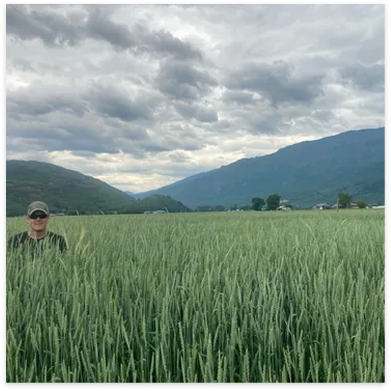
We produce certified organic grains and forages on 325 acres of production land in the Salmon
Arm area.
Our crops selection and rotation is prioritized as follows:
Field crop history, disease pressures, nutrient management and soil health goals
Human consumption crops
Livestock feed – we believe that the real strength in livestock production is utilizing what doesn’t
meet human standards so the grains produced almost always go for human consumption if possible.
Some of the crops that we grow such as faba beans are very difficult to find for feed production and
provide specific benefits to our livestock in addition to being a great fit in to our crop rotation.
Focus
Nutrition
We use a balance approach to our fertilizer program while maintaining organic integrity. We soil test regularly to form the basis of our planning and start with granular amendments like potash, sulfur and calcium. The manure nutrients produced on our farm are extremely valuable. It’s critical that they are used as efficiently as possible and that they are cycled within our system. We build our own compost material with the manure from the layer barn supplemented with materials from surrounding farms. We follow that with plant tissue testing in season which allows us to design a foliar feeding program specifically to that crop’s needs and plans for future years.
Soil Health
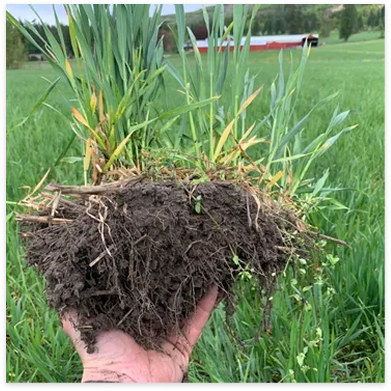
We are heavily focused on soil health and rebuilding our soil organic matter levels. Diversity and nutrient holding are critically important so our rotation includes as many acres of cover crops as conditions will allow. We also have a diverse rotation including legumes, grasses, flowering and perennial species. We perform a ton of trials of crop species and fertility sources on this farm, our belief is that we need to continue to understand the relationships between livestock, plants, minerals, organic matter and soil biology. We are excited to say that our efforts are yielding results as our soils on average have gained 1% of organic matter after 6 years of management. It doesn’t sound like much but that equates to almost 12,000 lbs of carbon per acre, increases our water holding capacity by 20,000 gal/ac, and provides a “bank” of available nutrients for future crops. While we hesitate to call ourselves a “regenerative” farm just yet we are working hard to adopt those principals and improve our system.
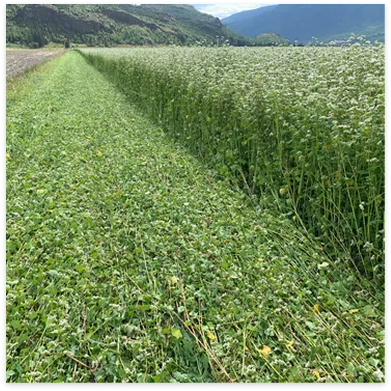
Cover Crops
Plant diversity and nutrient holding capacity are critically important so our rotation includes as many acres of cover crops as conditions will allow. Cover crops are an excellent tool for soil and nutrient management and, if managed efficiently, a great source of value for the farm. They are grown during shoulder seasons to hold soil particles together and tie up nutrients in root zones and organic tissues, reducing the risk of erosion and nutrient leaching. In addition they provide critical habitat and resources for soil microbial life which provide incredible benefits to soils, crops and nutrient dense foods that we don’t yet fully understand!

Sign Up To Our Newsletter
Subscribe to our newsletter to receive updates